Trap Doors and Memories

So many of us live inside our own pasts. More aptly, we re-live events, relationships, experiences both great and small, distinguish the beatific from the blasted. Some recollections are tinted with gold, but others carry curses long-affixed.

There is a danger in lingering for too long in the realm of memory. Some of us - and I am often one - prefer the company of the old friends and kin who still wait for us there, who knew us when we were young and blessed with charm and affability. But be careful; they are illusions speaking to us from the vaults of the past as real life pulses around us, carrying us too quickly toward the only certainty we have.

For me, social media has convoluted our general perception of the past. There is no way in heaven or on earth that the bald, sixty-something year old fellow who has ‘friended’ me on Facebook is the same one with whom I labored in the trenches of glory on a high-school football field. In the same way, he looks at me, sees the wrinkles and thinning gray hair, and says to himself, “It cannot be.” But here is the thing: when we think of ourselves, neither of us sees the aging man or woman who really is. We see the boys and girls that we were. Have you  ever caught sight of your reflection in a storefront window and thought, “Who is that old fart?” If so, then you know what I am getting at.

I experienced this jarring collision of past and present again three years ago when a friend from college days, Quynh Ngo, reached me through those ubiquitous, invisible filaments. Of course, it is always the face that first gives us pause. Could that really be Quynh, the 18 year old kid with the easy smile and the quick, dark eyes that missed nothing? And then, after a moment or two, I saw him: the boy was in there, looking back at me, and I heard him saying, “Trippe! Whatchu doing?”

I first met Quynh in 1983 in Gainesville, Florida, when I wandered (almost on whim) into the Cuong Nhu Center for Oriental Arts on University Avenue. I was a graduate student at UF, working hard most of the time and drinking too much the rest of the time, and I felt myself falling into poor physical condition for the first time in my life. Quynh was a young black-belt instructor from Vietnam, and after just a few minutes talking with him, I knew that I would become an unlikely student of karate and that Quynh and I would become good friends.

His family - his parents, two brothers, and a sister - were from the city of Hue in Central Vietnam. His father, Ngo Dong, had been an officer in the People’s Defense Force of Hue and spent time in a “re-education camp” after the war. In 1977, in a daring effort that has been well-documented in the Gainesville Sun and other publications, Dong formulated a plan that would drastically alter the future that had seemingly been laid out for them by the new ruling communist party. On a dark night in June, all six family members secretly boarded a small fishing boat and left Saigon behind. Many days later, they were picked up by an Indonesian freighter in the South China Sea and eventually made land at Djakarta on June 27th.

Somehow, months later, through the same tenacity and resolve that have long been characteristic of immigrants to the U.S., the Ngo family was well-established in Gainesville. The children were doing well in school, and Dong was a doctoral professor of etymology at the university. He was also the founder and creator of the Congo Nhu style of martial arts, which has ultimately grown to include more than seventy-five schools worldwide. He became somewhat of a legend in Gainesville and beyond, a man who had seen combat and yet professed peace, a philosopher with the spirit of an ancient warrior. When he died in 2000, his second son, Grandmaster Quynh, was named the head of style for Cuong Nhu.

At this point, I should inform the reader that Quynh Ngo died from the COVID 19 virus on September 1st, 2021, at the age of 56. Many of those who knew him best, including his younger brother Anh, himself an accomplished practitioner and instructor of martial arts, have said they knew of no one who was in better physical condition, of any age, than Quynh. A lifetime of training had also made him mentally tough and resilient in the extreme. As a child, he had survived not only a bloody war in his homeland but also a dangerous bout with malaria. Without question, his death was tragic, unjust, unnecessary, and infuriating; but I do not intend this piece as a lament or elegy, or even simply as a sad, true story, which it certainly is.

I have two purposes here really. One is to say that, although life as it occurs is certainly not much like any of the best stories I’ve ever heard or read, in that much of it seems random, accidental, meandering, senseless - there are stories that we can discern only long after their context has expired. The meaninglessness of the present and recent past gains clarity with time’s passage. We may only learn years after an event what has really happened to us. Stories, like any worthwhile craft or art form, must be told only when they are fully formed in the mind, and this process can take decades. To reiterate, then: we must not live too much in the past. To do so means that we miss too much of the raw material that is all around us at any given moment. We must not let the portal of memory become a trap door. To my second, perhaps even more cryptic point: those who inhabit our memories are static; they cannot - they must not change. But to be fair to their humanity, when we meet our friends again after many years, we must accept the people they have become, the ones who dwell in the present.

I am not shouting “Carpe diem!” This is no rehashing of the “Live for the Moment” mantra that comes and goes with various generations of young Bohemians. Memories of ourselves and of others as we may once have been are well and good (except when they become nationalized nostalgia and thus potential fuel for political agendas, as though simply moving backwards through time will make us all “great again”). Quynh the boy was an alluring figure. He gleams in my thoughts, and the things he had endured as a child - war, malaria, a long journey to freedom - made the spark all the brighter. But Quỳnh the man also exuded the kind of love that defies the bonds of time as we know them.

If you were to ask me whether I would go back, would return to those salad days, that academic life of reading and writing and discussion and then afterward the warm intensity of the dojo on University Avenue, the camaraderie of young people strong in body and mind, all in our white gis, snapping obediently to attention at the barking of Quynh’s voice: “Left side! Left-hand block! Right-hand punch!”, when my only responsibilities were to myself and to my friends and I had no other real ambition because I had opportunity and ability and things seemed to come to me easily, I would probably say…yes. I would go. But…what would I stand to lose? What of the wisdom that really does come with time, and the long arc of joys and sorrows mingled more poignantly than the best of artists might conceive?

Ultimately, when I had earned my master’s degree at UF, I had risen to the rank of brown belt, but I soon left Gainesville and drifted away from Cuong Nhu and the Ngo family. Yet when Quynh contacted me online, I truly felt that I was speaking to a member of my own family. When I learned of all that he had achieved both in the business world and as a master and instructor of martial arts, I felt the pride that one might feel for his own brother. Past and present, memory and awareness, were no longer divided.

I am lucky to have known Quynh and his family, even though when I was around them all, which was nearly every day during the early eighties, I was oblivious to my own good fortune, of course. How could I have known that the Vietnamese meal that Quynh’s mother, Chau Thanh, made for me when I visited their home, would stand the test of time and rank against the finest meals I’ve had in Paris and New York City? How could I know that Dong’s calm voice would return to me in times of personal turmoil? And how might I have guessed that any meager understanding I may now possess of human relationships in the context of time, as it shoves the days and weeks and months and years between us, would one day be changed and deepened by a friend named Quynh?

Quỳnh Ngo (image from cuongnhu.com)

Metaphors For Sale

For many years, word games and wordplay have been an important part of my life. For me, the fulfillment of any real responsibilities depends very much on the day of the week: Mondays through Thursdays, in general, I am available for meals, doctor’s appointments, bathing, and other mundanities. You see, on these days, the New York Times crossword puzzle is reasonably solvable - for me, anyway. But Fridays through Sundays? No, on those days, I must wrestle time away, steal the minutes and hours here and there from the people - family members, students eagerly waiting for their essays to be graded, friends wondering what they’ve done to offend me - who, no doubt, would say I should be doing something more constructive than scribbling letters into little boxes.

And this is to say nothing of the time I expend playing Spelling Bee, Wordle, the Word Jumble, and the cryptogram.

I am a very good Scrabble player, too. Although not at the level of Grand Master, I can usually beat most people I know (the exceptions will not be named here, damn them). However, my true obsession is with solitary games in which it is just me and the clues in front of me. Still, now that I think of it, the player is, in a sense, engaging with the delightful minds of puzzle editors such as Will Shortz and, years back, the brilliant Eugene Maleska.

My broader interests also include puns - a far more spontaneous art form, a dash of impromptu wit. I have often used puns in my English classes when teaching vocabulary, although I am not sure that it actually enhances their learning. I think the best one I ever came up with, on the spot, concerned the word “turnkey.” My example for its usage in a sentence was…

For Thanksgiving dinner, the rebellious prisoners had stuffing, cranberry sauce, and

roasted turnkey.

Of course, a pun such as that one must always be immediately followed by a sincere apology.

In teaching poetic forms, when seeking a diversion from sonnets, villanelles, and odes, I sometimes offer my students limericks. For some reason - perhaps because of its overall ridiculousness - a good limerick practically guarantees a laugh. At one time, I could actually improvise limericks using my students’ names. Example:

I once had a student named Hugh,

a very bright kid, in my view.

I railed when I heard

he’d been labeled a nerd,

but he said, “Sir, no worries. It’s true.”

Obviously, that’s just good clean fun, but in younger times, during an especially odd phase, I took to memorizing dirty limericks. Believe me when I say that dirty limericks can be very dirty, gutter dirty, triple-x-rated dirty, full-dumpster-rotting-in-the-midday-sun-dirty. Just think of all the filthiest swear words in English that you know, and imagine the possibilities. I once knew some of the dirtiest ones, far too dirty to print here (but if you send me a private email request, I’ll be happy to share one with you). In fact, I was once kicked out of a faculty Christmas party for reciting some of them. What follows is the tamest one that I can recall. It is not particularly dirty, but it makes for a good opener.

A jolly old sailor named Bates

could do the fandango on skates.

He fell on his cutlass,

which rendered him nutless

and practically useless on dates.

Now, all of this presents a problem for anyone who regards himself or herself as a writer: an obsession with words (“word flu” I like to call it) can creep like kudzu into one’s attempts at serious work. You begin to wonder how well the reader might be paying attention and what you might be able to get away with. Case in point:

All that summer, Contessa spent the heated hours hoeing among the rows of pole beans on her uncle’s farm outside Modesto. By August, all the villagers agreed that she was the best hoer on the farm.

Nonetheless, I have tried in vain to concoct a scheme by which a competent writer who is not an international bestseller might actually be able to earn a living without having to go to work as a teacher or a copy editor or as a writer of manuals for the assembly of vacuum cleaners. For instance, I thought, the publishers of those trashy, pseudo-literary novels might wish to spruce things up a bit by including carefully crafted, descriptive metaphors in their books. “That’s it!” I exclaimed. “I’ll come up with a few random, meaty passages and try to sell them on the open market!”

Here are some of the results:

    His voice was a swirling leaf, tossed briefly upon the wind but dying, finally, in the

silent muck of the turd-colored pathway.

And…

      From somewhere deep beneath Elizabeth’s crinoline skirt, a fart puttered up and  

insinuated itself upon the air, rather like a broken tractor rolling to a stop in a wet field.

      She glanced up coyly and smiled at the gentleman seated across from her in the 

train compartment.

Here’s one I’m particularly proud of:

    Simon gazed down from the tall bridge’s railing and contemplated the river’s 

undulating foam far below. ‘Yes,’ he thought, ‘only three seconds of terror, and then…

and then…’ He knew that he must go through with it. The dull grey light over New York

had broken in upon the sickbed of his memory, all his devil-may-care-years and his

willful refusal to separate the paper, the plastics, and the glass bottles, throwing them all

wantonly into the same bin. He could no longer stand himself, and he felt his foot

edging outward into the thin air…

This one was actually under consideration by a small publisher of romance novels, briefly:

    Henry thundered into the bedroom with the Visa bill in his thick hand. He reminded 

Joan of a bull moose in the spring, his horns shorn of their velvet, uncertain whether he

is driven mad by anger or desire. She turned softly on the settee, letting the sequined

straps of her teddy slip even further, further, across her slender collarbones and scented

shoulders, until the angry blood in Henry’s eyes began to ebb, and then, as always,

collapsing into her arms, he became the fawn… Yes, that’s it, a fawn, all brown and soft

and furry and fawn-eyed as she stroked him…

Although none of these has quite hit the mark yet, I haven’t given up on the idea. On the other hand, if nothing ever comes of it, an adage will be born: No matter how badly you try to do a thing, there is always someone who can do it a little worse. It reminds me of a remark made once by Groucho Marx, who was a great punster. One of the directors for the Marx Brothers’ films at MGM during their heyday in the 1930s was a fellow named Sam Wood. The story goes that Groucho, at a cast party, overheard Wood complaining about the comedian’s lack of training as an actor. Not knowing that Marx was standing behind him, Wood said,

“What do I think of Groucho’s acting? Well, you know, you can’t make an actor out of clay.”

Groucho leaned his head into the conversation and quipped, “That’s true. And you can’t make a director out of Wood.”

Honor Among Boys

Warning: adult language and situations (oh, the irony)

Sometimes a story chooses its own time to be told.

In Brunswick, Maine, about a twenty-minute drive from my home in Yarmouth, some high-school football coaches have made the national news. According to CBS Sports, head coach Dan Cooper was fired last month after an investigation into a “sexually-charged hazing incident during a preseason team retreat.” For those who may wish to know (meaning most of us, I’d suspect), the incident “involved a player being held down and having a sex toy put in his mouth.” Evidence included videos shot by other students on their phones.

As horrifying as this may be, it is not by any means an anomaly. As we have seen, young athletes are sometimes abused by those they would trust. Training techniques, equipment, performance standards, data research…all these things have improved and helped to advance the sporting world. Human nature has not.

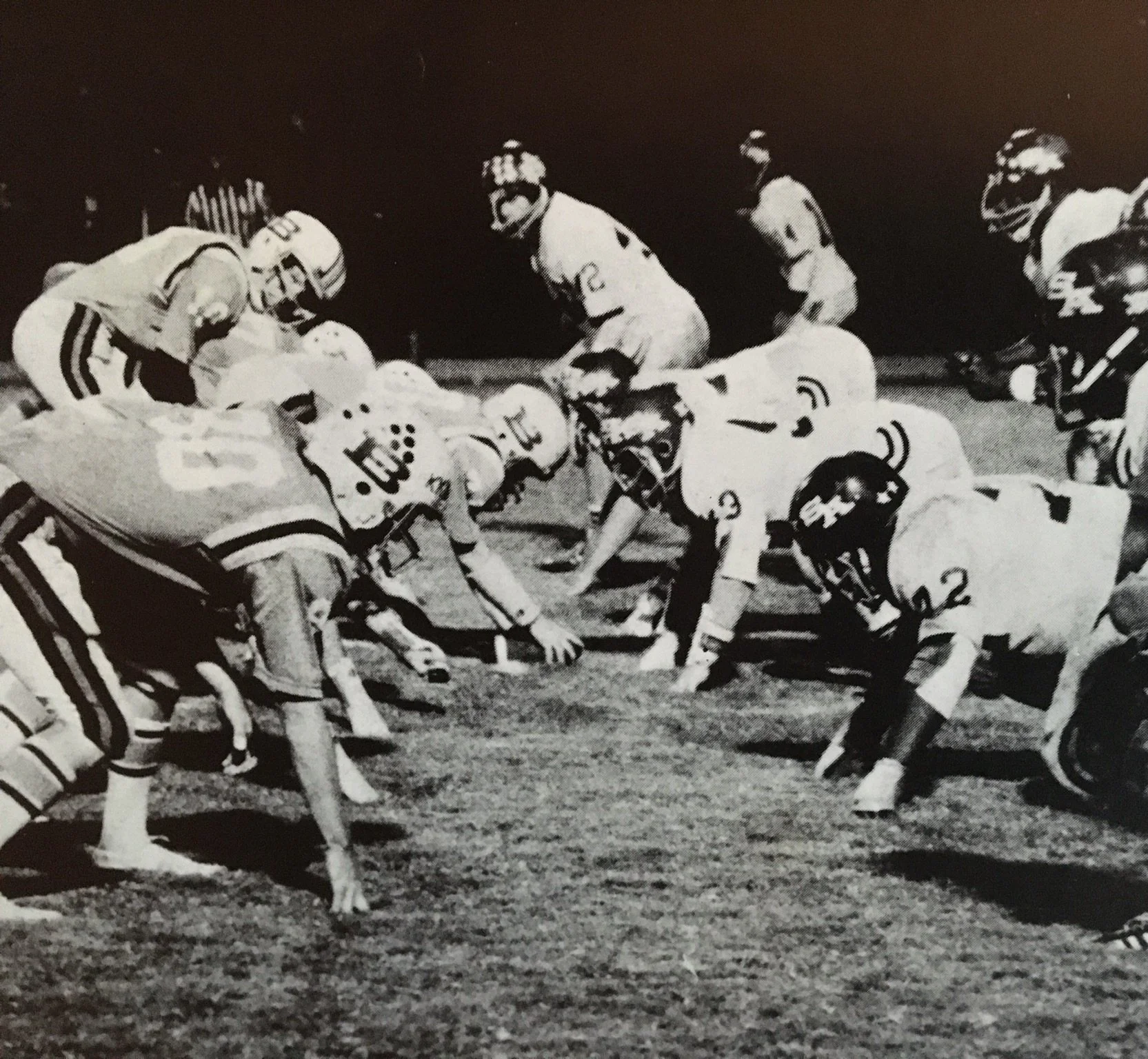
Now, to be quite honest, Maine does not have a storied American football tradition. Google reputes that the most famous player to hale from the Pine Tree State was someone named John Huard, drafted by the Broncos in 1967. By way of contrast, even though it wasn’t really my decision, I grew up playing sports in Jacksonville, Florida, where the pressures on young athletes tend to be greater. By the mid-1970s, certain high schools had become showcases for college prospects, and as I was merely an average player, I was never in that exclusive gene pool. But my alma mater, the Bolles School, was and continues to be one of those places. The stakes are high there, and upon them rests a carefully balanced table of measures: not simply athletic potential, but also such intangibles as personal reputation, popularity, economic opportunity, family legacy, and - among boys - a peculiar sense of honor.

High-school football in Jacksonville is a religion whose churches convene on Friday nights, whose congregations are often composed of adolescent alcoholics-in-training,  half-drunk by halftime, of fathers whose own dead dreams for themselves are carried in corn-meal-sack-sized guts pressed against the chain-link fence, and of mothers who adore their little messiahs and brood like Mary on the aluminum benches of the grandstands.

Below, on the field, the passion play unfolds, a story of ancient male rituals and a barely bridled savagery spoiling in the dank September air.

I was there once, and I played my part. In the long week leading up to Friday’s contest, the team must prepare, of course, but in truth it would all begin for us in late August, when our coaches would require all players to attend a ten-day camp during which we moved into the dormitories at Bolles, situated on the banks of the St. Johns River. It was the part of the season we dreaded the most because of its physical, mental, and emotional demands.

Here are some of the ways in which our bodies were tested:

  • Coaches roused us every morning at six for a one-mile training run before breakfast. On a typical August morning in northern Florida, the grass is well-soaked in a sticky dew, and the sun begins to breathe down your sweaty neck as soon as it appears over the treetops. The mosquitos are up early, too, busy about their never-ending search for their breakfast of blood.

  • After our own breakfast (usually consisting of waffles and sausages from a frozen box), we would dress out and take the practice field for morning workout. We had dubbed the practice field the “Dust Bowl” because it was exactly that: a grassless pit of dark-gray dust that would collect on the sweat that streamed down our faces and arms. Warmups included calisthenics, stretching (misnamed because it amounted to bouncing on one’s muscles rather than stretching them), “drop-and-roll” drills, and a thing we called “six-inch killers,” done prone on our backs with our legs and feet raised six inches off the ground. It hurt like hell. After that, we ran drills using blocking sleds, a spring-loaded tackling dummy that we called “Big Red” (it could break your neck if you didn’t hit it just so), and various other torture devices.

  • Following lunch, we were soon dressed and on the field again for the afternoon practice, which would typically include a full-speed, full-contact scrimmage, the prime time when you attempted to prove your worth to coaches and teammates, if you didn’t keel over with heat stroke first.

  • Evenings, after a five-thirty dinner and a chance for the sun to begin to bleed back beyond the trees, we would be in the weight room, clanging and puffing away, and then we would meet at the track at 7 p.m. We never knew how many laps Coach would assign us, and he always relished the dramatic moment when he would smile, lick his lips, and then call out, “Gimme…gimme eight!” Or ten. Or twelve.

Suffice it to say that an early bedtime seemed a brief reprieve in between sessions on the rack.

Of course, I suppose there were certain kinds of ignorance for which we could not have held our coaches responsible. They did not know, for example, that bouncing on your hamstring rather than patiently stretching it actually increases the likelihood that you will injure it. They did not know that withholding water (or the nasty concoction that Chuck Solomon, our head coach, called “salt peter”) from young athletes did not make us tougher, but simply caused dehydration and possibly heat exhaustion. Nor did they understand that leading with the face mask when making a tackle would one day be deemed one of the most dangerous things to do in all of sports. Nor did they know that such a thing as concussion protocol even existed: I saw teammates knocked unconscious, out cold, in games, only to be sent back onto the field once the fog had cleared.

We could not necessarily fault them for those things, but their ideas concerning mental, psychological, and emotional tactics…well, that is another matter altogether.

Public humiliation was high on their list of instructional strategies. Name-calling was common: “shit-head,” “shit-for-brains,” “dip-shit,” “shit-bird” - all varieties of shit were articulated, but so were the conventional emasculating terms, such as “creampuff,” “peaches-and-cream,” “homo,” and the quintessential “pussy.” These were even more effective when served up with some sort of physical underscoring. Consider, for instance, the virulence of Coach Morgan’s remark, “Hey, cream puff, I’m gonna pull my leg back and cock it, and then I’m gonna swing it on the snap count. If you don’t fire off that line when you’re supposed to, I’m gonna put my foot right up your ass, cleats and all.” Now consider the effect of this declaration if you knew that Coach Morgan meant every word of it.

Praise be that Morgan was blubbery and hairy and really could not move very quickly (why he chose to come to practice without a shirt on, I will never know). Coach Solomon, on the other hand, was fairly nimble, and he was redneck-strong, like someone hired to sling tires off of the track at a monster truck rally, or who could chug two pitchers of beer and then beat everyone at the table in arm wrestling. Nonetheless, Morgan held the edge over him in psychological abuse. God help you if you had any glaring flaw about your appearance, as I did in the form of a bad case of acne, made worse by the sweat and dirt in which we were basted from day to day. During the football season, not only my face but my back and shoulders would bloom like a topographical map. Once I was waiting in a line at the water fountain outside the locker room after practice. We were all shirtless, having torn off our shoulder pads and our stinking, wringing-wet t-shirts as quickly as we could. Morgan walked behind me and sang out in a booming voice: “Damn, Trippe, you ‘bout got some acne, don’t you? Looks like a pizza I ate last night.”

It is odd how your best friends can laugh at your expense at such times, but I did not know then that it was that nervous laughter that says, “Thank goodness it was Trippe that was humiliated, and not me.”

In fact, as students of history know quite well, pitting citizens against one another is a tried and true practice in any tyranny. The same can be applied to a football team. But what is the point of it? The point is to strengthen the tyrant’s grip, because he is a frustrated egomaniac, and when he fabricates a conflict, only he can resolve it, thus fortifying his tyranny.

Coach Morgan had two favorite practice drills, one he called “Morgan’s Mountain” and the other “The King of the Kennel.” Morgan’s Mountain was a training run in full pads, with a twist added. We players would run a circular route, down the steep, sandy bank of the St. Johns River, through a stretch of malodorous mud, and back up another steep section of bank to start over again. One time through the course, and you were gasping for air, ready to puke, and besotted by heat, but you forced yourself to keep moving because of the caveat Morgan had added: “If you catch the guy in front of you, you’re allowed to do anything you want to him!”

I suppose he expected that we would be inclined to do bad things to each other: assault, vicious ball-kicking, forcible sodomy… In any case, through mortal fear, I always managed to keep just ahead of the kid behind me, as did everyone else.

By contrast, the rules of King of the Kennel, Morgan’s other brainstorm, demanded that each of us, at some point, would show what we were made of. The kennel was essentially a cage constructed of a metal frame with chicken wire stretched across its top and two of its sides. Two players would face each other from the open ends, in three-point stances, and we would wait for the whistle. On that signal, we would go at one another, with the object being either to drive your opponent back out the side by which he had entered, or turn him on his back, at which point you were supposed to attack him viciously, punching, kicking, anything that seemed apropos to the moment. With helmets and pads on, there was little danger of anyone actually being hurt, but the trauma of squaring off with your teammate in what seemed at the time a fight to death was unsettling to say the least.

I remember punching my good friend, Chris Vann, over and over, until one shot slipped under his face mask and caught him on the chin. We abruptly stopped our grappling, and he gave me a look that was both surprised and sad. On our next go-round, Chris was able to turn me over and ended up sitting on top of me, with Morgan hovering over the kennel and yelling, “Hit ‘im, Vann! Kick his ass!” But Chris did not hit me; he simply stared down at me with that same sad look. He and I knew - hell, all of them knew - I had sacrificed my honor, but he had not.

Still, I suppose it is one thing to smack your teammate under duress. I am certain that it is entirely another for a grown man of thirty or forty years, a coach no less, to physically attack a teenage boy. Yet that is what happened, time and again, on those dusty playing fields in the long-ago seasons of 1973 and ‘74, surrounded by scrub oaks on one side and the glinting river on the other, as the whistle faded away and the underling tribe fell silent. The film reel exists in the attic of my memory, where I attempt to let it lie, and yet sometimes, perhaps for no reason at all, it is taken out and played once again.

“Damn it!! You! Get over here!”

But before the terrified offender can take a step, Coach Solomon is on him. Maybe the kid has fumbled the ball (a mortal sin), or maybe he has not fulfilled his blocking assignment, or maybe his tackling technique is all wrong, or maybe he has simply smiled and laughed at the wrong moment. One never really knows what small thing might bring on the fever of rage, but there it is. Whop! Whop! Two stiff blows up against the earholes of the helmet. Now grab the face mask of this worthless piece of shit before he can instinctively recoil, and sling him around by it (but not too hard - we don’t want to risk any diagnosable injuries). Now pull him close and snarl redneck gibberish into his panicked boy-face before slinging him away and consigning him to some place of shame - the bench, or the back of the line when at last it comes time to drink the salt peter, with a kick in the ass for an exclamation mark. And the rest of us turn away silently, each of us wondering… Am I next?

But the thing we had just witnessed was quickly sealed up in the tomb of shame; I, for one, never said anything to my parents about these kinds of episodes (for one thing, I knew how my father would have reacted; he had no reluctance in disciplining me himself, but God be with anyone else who ever laid a hand upon me), and I suspect the same held true for my teammates.

The rules of good writing prescribe that the writer must not comment on an action he has just rendered. If he has done his job, there is no need. In this case, however, I am troubled by questions: What was the rationale for all of this? Was it supposed to prepare us for “the game of life”? Was it crafted to make us tougher and more determined than our Friday-night opponents? Or was it the displaced anger, driven by certain failures, of men whose own pasts had been peopled by monsters and demons? Secondly, why did we players, as fairly intelligent youngsters, continue to go back day after day, week after week, season after season? Was it because we, too, believed it was good medicine? Was it a restless desire to be accepted, to be somebody - a football player? Or was it simply a distorted code of honor thrust upon us by men whose time had come and gone long before, who wielded the club of authority not because they cared about us but because they hated us and the opportunities that being young would hold out for us? 

I don’t have the answers, but I can offer a few postscripts to this recollection.

Our lives (and hence our subsequent memories) were changed significantly in my senior year, when an entirely new coaching staff was put in place. Our new head coach was a former college quarterback from Ohio, young, with up-to-date ideas and a philosophy of optimism and encouragement. The days of King of the Kennel and salt peter were over, and to us, it was to be a season for the ages.

A good many years later, I was out enjoying a couple of beers with an old high-school friend and teammate, with whom I am still in touch, and who has been a successful attorney for many years now. We were talking about the old days of football camps and related tortures, and he remarked, “You know, Jeff, the truth is that if that type of thing happened today, our coaches would probably be up on child-abuse charges.” He was not smiling when he said it.

I heard that Coach Morgan died in 2014, but a few years before that, I happened to run into Coach Solomon one afternoon when I was still in my forties. He was working in a Jacksonville sporting goods shop, and I went in to buy my son a new bat for little eague baseball season. When I walked up to the cash register, Solomon recognized me first.

“Trippe,” he said quietly. I looked up. “It’s me. Coach.”

We chatted briefly about nothing. Yes, yes, I’m a teacher now. Yes, I knew you had left coaching. No, I haven’t really seen much of anybody from the old days. They’ve all gone off in their own directions, I expect. Then I gathered up my packages, and he looked at me, smiled his lumpy smile, and said, “Well, take care.” Over time, I have managed to convince myself that I saw a small glow of regret in his dark eyes.

Another friend told me that he’d had a similar experience around that same time, had gone into the same store and, just like me, encountered our old football coach, except that in his story, Solomon had gone into a lengthy reminiscence that ended with a heartfelt apology for having “lost his cool” with us a few times, all those years ago.

Otherwise, I have lost the trail of my old coach’s life.


MLK Jr. in St. Augustine: a month in the life

In January of 1990, I was working as a daily reporter for the St. Augustine Record. I had been making a living as a journalist for a couple of years at even smaller newspapers in Florida, but I viewed the Record as a significant step up the ladder for me. Its circulation was still modest, at about 16,000, and the pay was dismal, but the paper had a reputation for integrity and objectivity. Besides that, St. Augustine was the sort of town that pulled you in: despite  unchecked real estate development outside the town limits and a roaring tourist trade, it retained a laid-back Old-Florida vibe. At lunchtime, I could walk down to the Pharmacy on St. George Street, hobnob with two-bit attorneys and town councilmen, wolf down a greasy cheeseburger, and be back at the office in time to file my stories for the next day’s deadline. Then it was straight down to the Mill Top or Scarlett O’Hara’s or the Trade Winds for a beer or two to wash away the day’s dust.

On the morning of the third Monday that month, my editor, Steve Cotter, said to me: “Trippe. Assignment for you. Run down to the town plaza around one o’clock this afternoon. And take a camera with you, ‘cause I think Studwell is tied up already. There’s supposed to be some kind of memorial down there for Martin Luther King Day.”

The paper had given me the use of an old Pentax that I loved ardently. Our staff photographers (all two of them) were excellent, but I often had to take photos for my own stories, and that Pentax had become my traveling companion, reliable, with manual functions, although it was dented up, and the external flash stood at a crooked angle like the Tower of Pisa. But the images it produced were consistently good, and I surprised myself at times with the quality of my own pictures. “Damn, Trippe,” Studwell would say. “Not too shabby.”

Of course, at that time, very little that I did - professionally at least - was planned, and everything that just happened to turn out well for me seemed simply another stroke of good fortune. Nevertheless, looking back now, I see that what I considered pure dumb luck, especially for someone who had no real training in journalism (my degrees were in English and creative writing), I actually owed to a certain man. His name was Pete Osborne, and although I didn’t know it at the time, he was a significant mentor in my writing life.

Pete’s title at the Record was ‘Senior Reporter.’ He was 56, and not too terribly long before I arrived there, he had been the newsroom editor. Over the lunch table, he was a raconteur of the first calibre, and most of his stories were so disarming as to be true. For instance, he made a strong case that as a cub reporter at the Mount Dora paper, he had broken the Cuban Missile Crisis story. As he told it, he was looking out the window one morning and noticed dozens of military trucks passing by on Highway 441, and simply called the Florida National Guard to ask what was going on. He also claimed to have been the first news reporter in the state to ask for copies of  911 tapes under the Sunshine Law: one night in the fall of 1988, a young girl at the Florida School for the Deaf and Blind became disoriented in the school’s showers, and she was scalded to death. The tapes Pete requisitioned showed that the ambulance that was dispatched to the scene that night was inadvertently re-routed, and the girl died in those crucial lost minutes.  

When he told me that story, I could read the pain in his eyes. He was relentless on the job, but his savvy was tempered by compassion.

He was also an alcoholic. That was why he had been demoted from news editor to reporter. Apparently, the day after he had spent the night in the St. Johns County jail for driving under the influence, he managed to arrive at work on time, only to find himself in the uneasy situation of having to write the news story about his own arrest. It was a crisp, six-column-inch piece of reporting, and it appeared in that afternoon’s edition.

When I met him, though, Pete had been sober for about ten years. And as a sober man, there was no one more trustworthy or well-meaning. His intelligence and his memory for detail were as keen as a well-whetted band saw, and his professional advice, which never actually sounded like advice, was offered in such an offhand way that it all seemed just a matter of common sense. Nearly all that he said came with a sly smile beneath his thick grey mustache, and that sort of humor that assumes you are in on every joke. 

There is much more to tell about Pete, and I hope to tell it all eventually, but suffice it to say for now that on the third Monday in January, 1990, he had a few words for me as I passed his desk on my way out of the newsroom to cover the Martin Luther King Jr. commemoration ceremony at the town plaza. He was just hanging up his phone, and he swiveled about in his chair to face me.

“Hey there, kid, hang on just a sec before you roll out. Do you happen to know what’s up on the third floor of the building we are in at the present moment?”

“Of course I do, Pete. The archives.”

“Correct. You continue to exhibit potential. I’m only asking because I thought that if you’re going to cover the MLK event, you might want to wander upstairs as soon as you return, before you write your story. Far be it from me to tell you what to do, but I assume you’d like an interesting angle on this.”

“Always.”

“Okay, well then, I suggest you look in the photo file cabinet marked June of 1964. To be more exact, you’re looking for June 5th to roughly June 20th, I believe. You’ll find some pretty interesting things in there.”

“Can you give me a hint at least?” I said. “I was only six in 1964.”

“Well, for one thing, there was a piece of legislation called the Civil Rights Act, but I’m referring in particular to the events  of that summer in St. Augustine. Dr. King was in town then with a number of his followers, protesting segregation. In fact, he was arrested here. Big doings up at the Monson Motor Lodge. You’ll see Jimmy Brock’s name in those files, too, I think.”

Pete had introduced me to James ‘Jimmy’ Brock, the owner of the Monson Motor Lodge, at a chamber of commerce soiree some months earlier. He was in his mid-sixties at the time, and he had that wide smile and southern affability that said, “Welcome! I don’t know who the hell you are, but welcome!” As Pete affirmed afterwards, most everyone in town regarded Jimmy Brock as ‘a great guy,’ and I had no reason to believe otherwise.

He went on: “You’ll find lots of photos up there from Dr. King’s visit. Just a little background info for you, that’s all. Use it as you see fit. But remember - a newspaper is a historical document…” Now his forehead became wrinkled in thought. “You know, the more I hear myself talk about this, the better this gets. This could be a dern good story for, you know. Juxtapose your photos with some of those from ’64. Yeah. If I were you, I’d make sure I get up to the archives.”

“Thanks, Pete, I’ll try and make time for that. I’m under deadline, you know.”

“Yep. Every minute of every day.”

And then I swept out the door, a young reporter in a hurry, my Pentax swinging from my shoulder and my notepad in hand.

As it turned out, the commemoration ceremony, which was held, ironically enough, near the old slave market that fronted Matanzas Bay, was rather low-key. About two dozen people, white and black folks of varying ages, listened to an impassioned but barely audible speech delivered through a whistling p.a. system by a professor from a local private college. Everyone clapped politely, nodded, smiled, and then went about their business. After all, it was wintertime, and even in St. Augustine, when the saltwater-laced wind whipped over the railings along the waterfront, a damp chill would press into one’s bones.

I did see a familiar face, however. Moses Floyd, whom I had interviewed the preceding September for a story about his collection and transportation of food and other supplies for South Carolinians affected by Hurricane Hugo, was striding intently across the plaza, head down, when I sidled up next to him.

“Hey, Moses.”

He looked up and smiled. He was only a few years older than I was, but he was well into his career as a teacher and coach at the local high school. “Oh, hey there, Jeff,” he said.

“So, what’d you think of the speech?”

He shook his head. “She meant well. Kinda hard to hear, though.”

“I agree. Disappointing. I was able to catch a couple of sentences that I guess I can use in my story. Got a couple of decent pics of the speaker, too, I think.”

“At least she was standing still for you. You know, Florida only started recognizing MLK Day as a national holiday the year before last. And for all the big talk you hear sometimes, we’re still kinda backward around here, I guess. Old Jim Crow ain’t all that far behind us.”

“Well, I wasn’t going to mention it.”

“You’re a good fella. I got to make haste. Doing some painting up at the church. You take care, now.” He turned to head toward King Street but then stopped abruptly and turned.

“Hey, Jeff, you’re not going to quote me, are you? That stuff about Jim Crow?”

“I wasn’t planning to.”

“Hm. Well, if you do, you can just refer to me as an unidentified negro.” He gave his big, toothy laugh and then went on his way.

As it happened, I returned to the Record’s offices with ample time to spare, and as Pete had suggested, after I stowed the Pentax and my notes, I climbed the narrow, sagging steps up to the top floor. Mind you, this was when the paper’s offices were in their former quarters on Cordova Street, just a couple of blocks from the old courthouse, and the building itself seemed to quake and quaver in a strong wind, and the smell of ink and paper from the presses down below permeated the workaday life and stuck to your clothing like stale sweat. I prowled deep into the grey metal file cabinets lined up like rickety headstones until I found the one containing local photographs published in1964.

Most of the pictures themselves, tinged by time to a watery sienna, slept their eternal sleep quietly in their bulging folders, and the faces of the deceased, surprised to be awakened thus, gazed up at me: action shots from American Legion baseball games, sour faces at county commissioners meetings, a woman in a bikini walking a poodle in the Spanish Quarter…and then at last, my index finger found it: June, 1964.

But the folder was utterly empty. 

“There’s nothing in there,” I said, as Pete swiveled around in his chair.

“In the archives?”

“In the folder for June, 1964. Nothing. Nada. Not a single photo. Everything else is there, every other month, but nothing for June.”

He leaned forward, put his chunky elbows on his knees, and looked down at the coffee-stained carpet. I noticed that the swoop of gray hair on top of his head had shifted to expose a bald spot. After a few moments, he said, “Let’s just think about this for a minute.”

We thought.

“You looked in the bottom of the drawer? They hadn’t fallen out? You’re sure?”

“Clean as a whistle. Empty as a grave on Judgment Day.”

More thinking. Finally, Pete stood up, put his hands on his hips, and then thrust them into his pockets. “All I can figure, then, is that somebody took them. The question is…who? And why?”

“Who was the photographer back then? Maybe we can get in touch with him. He might know something about it. Or maybe he kept them for posterity, or else he realized they could be valuable someday.”

“I doubt it. News photographers usually can’t think that far ahead. Anyway, I have no idea who took those pictures, and neither will anybody else around here. It’s too long ago, now. For all we know, he could be dead.”

“You’re sure they were in there? June of ’64?”

“Absolutely. I’ve seen ‘em. Ran across ‘em a few years back when I was researching some piece of crap story about some St. Augustine High School alum opening a golf course, or some such crap.”

“Weird,” I said. “It’s almost like it never happened at all.”

At this, Pete looked at me closely, mouth slightly open, eyes narrowed, as if he were trying to figure something out about me, or perhaps had just noticed something in my appearance that he hadn’t quite caught before. Then he gave a raspy cough and said, “I’m going outside for a ciggie. You’d best get on that story. Just go with what you have.”

What I had was not much. It sucked, to be truthful. As I recall, it ended up on page two of the local news section (no photo) instead of on the front page, above the fold, as I had anticipated it would when Steve Cotter had approached me that morning. Nevertheless, I shrugged it off, and when that afternoon’s paper went out, my story was widely overlooked, no doubt, merely another unread chronicle destined for deep sleep in the archives. Oh, a few people - aside from the handful that had actually attended the “event” - might have glanced at it and muttered something like “Well, isn’t that good to know? Says right here: ‘Martin Luther King Jr.: Not Forgotten.’”

__________


In the world of newspapers, there is always the next day. The story the reporter wrote and filed today is no longer of concern to him. Like dust across a creaky wooden floor, it is swept away, and it is tomorrow’s story that really matters. Seldom does he pause to heed Pete Osborne’s simple observation: a newspaper is a historical document.

It took me years, long after I had left journalism to become an English teacher, to piece together what had actually taken place in St. Augustine in June of 1964. The events of those few weeks may seem a redundancy in our country, sadly, a tale of suffering, violence, and immutable courage. They are well-documented and easily accessible to anyone who can use a search engine on the internet today, but even now, although they proved to be an integral part of the Civil Rights Movement, I don’t believe they are widely known or discussed.

Dr. King arrived in St. Augustine around June 5th, at the behest of Robert Hayling (the first black dentist admitted to the American Dental Association, by the way). Hayling had become deeply involved in protests against segregation in the Ancient City and had founded a chapter there of the NAACP Youth Council in 1963. Hayling and members of his chapter met brutal resistance from the local Ku Klux Klan when they attempted to use whites-only swimming pools and other public facilities. Tensions rose significantly when African-American youths staged a sit-in at the Woolworth’s lunch counter, where a number of them were arrested. Hayling promised that he and his followers would defend themselves against attacks by the Klan, with firearms, if necessary. Conflicts continued through the spring of ’64 at beaches on nearby Anastasia Island.

Enter MLK, Jr. Accompanied by Dr. Ralph Abernathy, Andrew Young, and other friends and associates (including white supporters), he worked closely with demonstrators to draw attention to the injustices of segregation in St. Augustine. King himself went to the Monson Motor Lodge and attempted to dine at the hotel’s restaurant. He found himself in a face-to-face confrontation on the front steps with the owner - one James ‘Jimmy’ Brock. Dr. King was arrested.

That was on June 11th. On June 18th, several demonstrators jumped into the swimming pool at the Monson. In a response that would bring him a degree of infamy, Brock poured what he claimed was muriatic acid into the water. Although that substance, commonly used in pool maintenance, is not especially life-threatening, it can cause severe burns to the skin. A few minutes later, in a curious act of what he no doubt believed was devotion to duty, a policeman jumped into the water and arrested members of the group. If the eyes of the nation were not already upon St. Augustine before that moment, Jimmy Brock’s actions ensured that they would be.

Shortly thereafter, the governor of Florida at the time, Farris Bryant, himself a segregationist, did what bureaucrats often do when faced with a crisis: he formed a committee to look into things. In the meantime, King had left for Washington DC to witness Lyndon Johnson’s signing of the Civil Rights Act on July 1st.

Although the Record’s own pictures of those events vanished mysteriously, there are in existence numerous photos from those tempestuous days, most of them taken by the renowned Associated Press photographer Horace Cort. They are still startling in their black-and-white starkness, with their difficult truths that we may wish would go away, but which must not.

I am guilty, too, in that I did not know my own history. I grew up in Jacksonville, half an hour up the road from St. Augustine, and yet even as a would-be chronicler of life in that particular place, I knew nothing of the town’s role in the story of Civil Rights. It’s no excuse, but the bloated tourist and real-estate industries along the east coast of Florida do not exactly use the legacy of racism as selling points in their brochures. Such are the sins of our past; we choose to turn away from them, bury them, “put them in context” and rationalize that they had nothing to do with us. Still, I was ashamed of my ignorance of the sufferings and heroism of others, and  I still am. It makes me wonder what else I may have missed.

My friend Pete Osborne could have told me, no doubt, but alas, he died of pancreatic cancer in   December of 1991.

The Monson Motor Lodge was torn down in 2003. James Brock died in 2007.


Photo by Horace Cort

Photo by Horace Cort


Photo by Horace Cort